A Decision Engine is the intelligence layer that turns application data, credit policy, risk models, and operational rules into a consistent lending decision. Instead of hard-coding logic across spreadsheets, LOS configurations, manual reviews, and one-off integrations, lenders use a Decision Engine to centralize how approvals, declines, pricing, stipulations, and next-best actions are determined.
For banks, credit unions, fintechs, and embedded finance platforms, the value is not just automation. It is control: the ability to change strategy quickly, explain decisions clearly, and improve performance without rebuilding the entire lending stack.

The New Control Layer for Credit Decisions
Every lender has a decision process. The question is whether that process is visible, testable, and adaptable, or buried across disconnected systems and tribal knowledge. As lending becomes faster and more data driven, static policy docs and manual exception handling just can’t keep up.
A modern Decision Engine acts as the operating system for credit strategy. It receives an application, evaluates the applicant against configured rules and models, calls external data when needed, applies policy logic, and returns a decision with the reasons, conditions, and downstream instructions required to move the customer forward.
How This Fits Inside the LendAPI Platform
Looking across recent LendAPI Platform Updates, the Decision Engine is not an isolated feature. It sits in the middle of a broader loan core: Product Studio and the LOS collect and structure the application, Flow Builder orchestrates the journey, Rules Studio and Model Studio evaluate the decision, and embARC LMS carries the approved loan into servicing, payments, documents, communications, and lifecycle management. For the release trail behind that architecture, see v3.2.2 on parallel flows and structured data, v3.1.5 on Flow Builder, and v3.1.4 on Rules Studio plus LOS/LMS data mapping.
That matters because modern lending decisions do not happen in one screen. They happen across intake, verification, fraud controls, credit review, pricing, documents, funding, servicing, and ongoing customer communication. A strong Decision Engine has to understand the full journey, not just the moment where an application is approved or declined.
What a Decision Engine Actually Does
At its core, a Decision Engine answers the questions every lender cares about. Is this applicant eligible? What data do we need? Which policy rules apply? What is the risk profile? What offer should we present? And if it is not a clean approval, what should happen next?
The strongest engines combine several capabilities into one decisioning workflow:
Policy rules: Eligibility criteria, knockout rules, fraud checks, state restrictions, product constraints, and underwriting thresholds.
Data orchestration: Calls to credit bureaus, bank data, identity providers, fraud tools, income verification, and internal systems only when they are needed.
Risk models: Scorecards, machine learning models, affordability calculations, and segmentation logic that help quantify risk and fit.
Decision outputs: Approvals, declines, conditional approvals, pricing, limits, stipulations, adverse action reasons, and routing instructions.
Auditability: A clear record of which data, rules, model versions, and decision paths produced each outcome.
Why Decisioning Cannot Stay Static
Credit strategy changes constantly. Macroeconomic conditions shift. Fraud patterns evolve. New data sources become available. Regulators ask for clearer explanations. Marketing teams launch new channels. Product teams introduce new offers. If the decision logic cannot move at the same speed, the business gets trapped between risk and growth.
A Decision Engine gives teams a place to adjust strategy without waiting on a full engineering release cycle. Credit, risk, product, compliance, and operations teams can collaborate around a shared decision flow, test changes in controlled environments, and monitor outcomes before scaling them broadly.
Rules, Models, and Humans Still Need Each Other
One misconception is that a Decision Engine is simply a rules engine or an AI model. In reality, it is the orchestration layer that lets rules, models, and human judgment work together. Rules create guardrails. Models identify patterns. Human teams define policy, risk appetite, exceptions, and customer experience.
The best decisioning systems do not remove human accountability; they make it easier to apply that accountability consistently. They allow teams to see why a decision happened, compare alternative strategies, and understand the tradeoffs between approval rate, loss rate, operational cost, conversion, and customer fairness.
The Metrics That Matter
A Decision Engine should improve more than speed. Faster bad decisions are still bad decisions. The right engine helps lenders measure and tune the entire decision lifecycle.
Decision latency: How quickly applications move from submission to outcome.
Approval quality: Whether approved applicants perform as expected.
Conversion impact: How decision timing, stipulations, and offer design affect completed loans or accounts.
Exception volume: How often applications fall out of automation and require manual handling.
Policy explainability: Whether teams can defend, audit, and improve the logic behind every outcome.
What to Look For in a Modern Decision Engine
A capable Decision Engine should be configurable without becoming fragile. It should support complex policy logic while still being understandable to business users. It should integrate with data providers and core systems without forcing every workflow into custom code. It should preserve version history, support testing, expose monitoring, and make compliance teams more confident rather than more anxious.
Most importantly, decisioning should be treated as a product capability, not a back office configuration task. The winners in modern lending will learn from every application, adapt quickly, and turn decision strategy into a real competitive advantage.
LendAPI LOS: Where the Decision Starts
The Loan Origination System is where the decision really starts. It captures applicant data, product selection, documents, consents, co-applicant details, merchant or dealer context, channel source, and the specific offer configuration the borrower is applying for. The cleaner this intake layer becomes, the better the Decision Engine performs.
Recent LendAPI releases have continued to strengthen this layer. Product Builder v2 improved how teams build products and borrower flows. Custom stages gave operators more control over the application journey. Salesforce integration brought origination closer to revenue operations. Co-applicant controls helped support more complex lending workflows. Those themes connect directly to Product Builder v2 in v3.2.1, co-applicant flow design, and LOS/LMS data mapping in v3.1.4.
Product Studio defines the offer: loan type, borrower flow, required fields, documents, disclosures, and product controls.
Application stages define visibility: teams can track the application in the language of their actual operating model.
Data mapping keeps systems aligned: LOS fields, partner data, and downstream LMS records can move together instead of living in disconnected silos.
LendAPI Decision Engine: Rules, Models, and Flow Builder Working Together
The LendAPI Decision Engine brings together Rules Studio, Model Studio, credit integrations, and Flow Builder so lenders can define how applications move, what data should be called, which checks run in parallel, and how the final outcome is produced. Parallel flows, structured JSON variables, re-pull credit, tradeline controls, joint pulls, on-demand credit pulls, and Rules Studio all point to the same principle. Decisioning has to be configurable, explainable, and safe to operate.
This is where the difference between a simple rules engine and a true Decision Engine becomes visible. A lender may need one branch to verify identity, another to run fraud controls, another to evaluate affordability, and another to call a model or bureau partner. Some branches can run simultaneously. Some should only run if a prior result requires it. Some should pause, wait, or route to manual review. The Decision Engine coordinates those paths while preserving an audit trail.
Rules Studio and Model Studio also make the strategy layer easier to maintain. Credit teams can refine thresholds, eligibility logic, pricing paths, stipulation triggers, and adverse action reasoning without scattering logic across integrations or one-off engineering work. That keeps decisioning close to the teams responsible for risk and performance.
embARC LMS: Where the Decision Becomes a Living Loan
A decision is not finished when the borrower receives an approval. The loan still has to be documented, booked, serviced, paid, modified, communicated, and reconciled. That is where embARC LMS extends the value of decisioning beyond origination. The same data and policy context that helped approve the application can inform the servicing journey after funding.
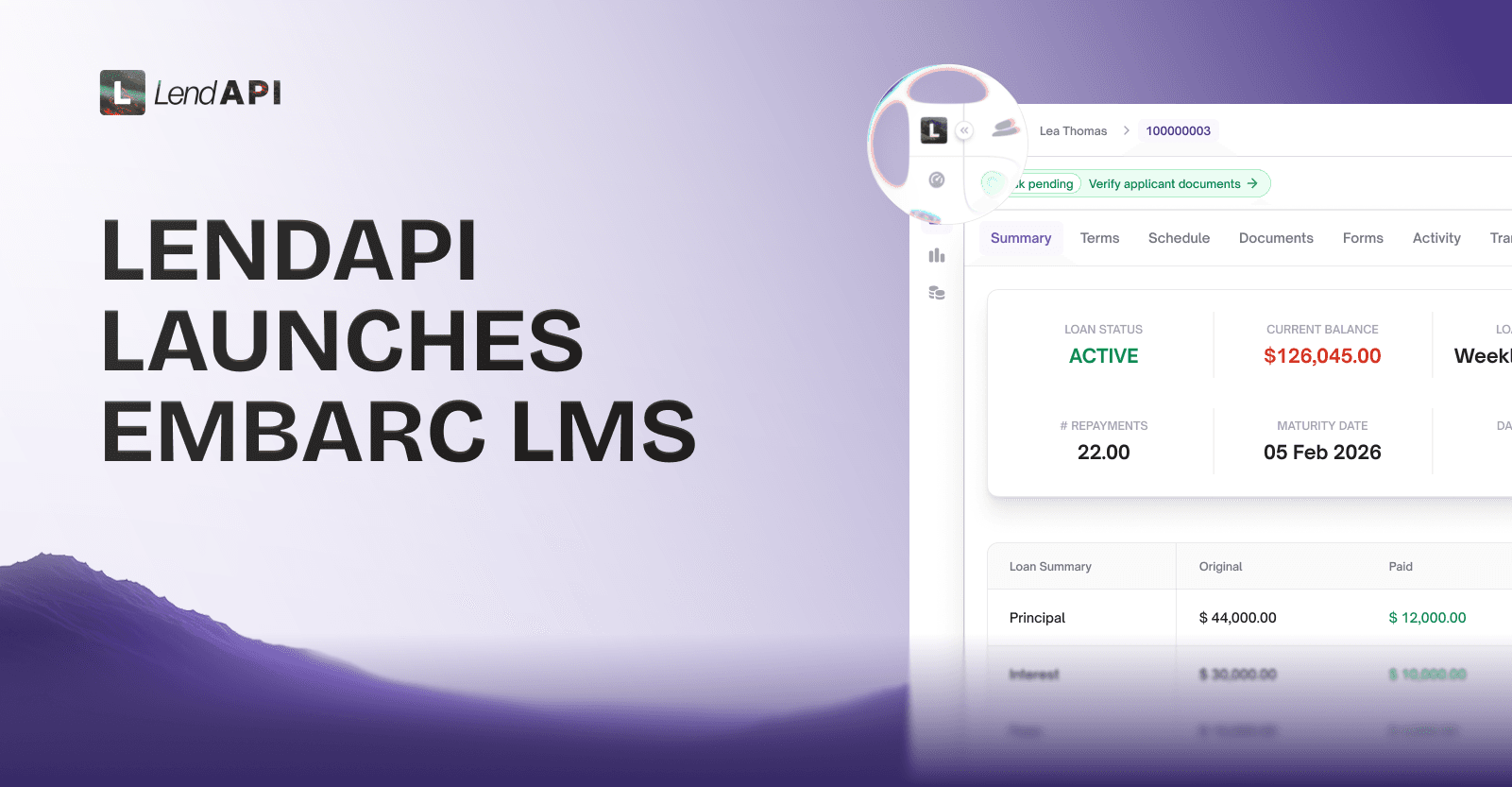
Older platform updates around embARC LMS enhancements, loan management flexibility, document center improvements, SMS templates, customer portal communication, and payment partner integrations show why this matters. The embARC LMS launch, the v3.0.6 Loan Management System enhancements, and the intelligent customer portal article all reinforce the same point: lending teams need continuity from application to account. If LOS and LMS data do not map cleanly, teams lose context, borrowers repeat themselves, and operational risk increases.
Servicing starts with decision data: approval terms, stipulations, borrower attributes, risk segment, and product configuration should remain available after booking.
Communications need context: customer portal, SMS, document requests, and servicing messages should reflect the actual state of the loan.
Lifecycle management needs flexibility: modern lenders need to support multiple loan types, payment paths, servicing workflows, and exception scenarios without rebuilding the core.
The Real Advantage: One Loan Core, Not Three Silos
Why This Foundation Matters
The practical advantage of LendAPI is that LOS, Decision Engine, and LMS are designed to work together. Origination captures the borrower journey. Decisioning evaluates and routes it. Loan management carries it forward. Each section strengthens the others when data, workflow, rules, documents, partners, and communications are connected inside one platform.
A Decision Engine is not just about saying yes or no faster. It is about building a repeatable, explainable, and adaptable decisioning foundation. That foundation gives lenders the confidence to grow while staying disciplined about risk.
That is the standard modern lenders should expect: not a brittle stack of tools, but a configurable loan core where every decision can be launched, explained, serviced, and improved.
About LendAPI
LendAPI is the core infrastructure for embedded finance and one of the fastest-growing embedded finance infrastructure companies in the world. Since 2024, we have provided market leadership in indirect financing across automotive, marine equipment, luxury consumer goods, services, and other high-growth lending categories. Our platform powers millions of financing opportunities for banks, credit unions, retailers, and fintechs. LendAPI gives teams a complete private-labeled solution, from customer experience and administrative tools to loan origination, decisioning, servicing, compliance, and licensing support, so they can launch financial products quickly and efficiently.
Follow LendAPI
![# Specialized Credit Origination, Compliance-First BaaS, Small Business Lending, and Community Banking Rails: A Deep Dive into Four Benchmark Sponsor Banks As Banking-as-a-Service (BaaS) and embedded finance transition into a regulatory-first era, fintech platforms, specialty lenders, and enterprise software platforms are fundamentally reassessing their bank partnership strategies. Simple middleware connectivity and rapid, unmonitored partner onboarding have been replaced by strict regulatory oversight, direct bank-to-fintech risk governance, and highly specialized balance sheet capabilities. Sponsor banks today must deliver high-throughput credit origination, precise risk monitoring frameworks, specialized industrial bank lending structures, and resilient deposit engines. Four landmark institutions—**Blue Ridge Bank, Celtic Bank, The Citizens Bank of Clovis, and Coastal Community Bank**—represent critical pillars across commercial lending, small business credit origination, and community-driven BaaS sponsorship. --- ## The Strategic Shift: Transitioning to Governance-First Bank Partnerships The era of lightly governed BaaS middleware is over. Modern sponsor banks operate directly as primary risk, compliance, and capital infrastructure providers: ``` +-----------------------------------------------------------------------------------+ | BENCHMARK SPONSOR BANK CAPABILITIES | +-----------------------------------------------------------------------------------+ | | | [Fintech Platforms / Specialty Lenders / SMB Platforms / Vertical SaaS] | | | | | v | | [Direct Bank Infrastructure & API Connectivity] | | | | | v | | [Regulated Bank Balance Sheet & Charter Frameworks] | | +-----------------------------------------------------------------------+ | | | - Programmatic Commercial & SMB Credit Origination (SBA 7(a), POS) | | | | - High-Oversight Deposit Accounts & FBO Sub-Ledgering | | | | - Industrial Bank Charter & Interest Rate Exportation Authority | | | | - Enhanced BSA/AML, CIP/KYC & Fair Lending Oversight Engines | | | +-----------------------------------------------------------------------+ | +-----------------------------------------------------------------------------------+ ``` ### 1. Nationwide Credit Origination & Industrial Charter Power Specialty lenders and point-of-sale (POS) finance platforms require chartered bank partners with national lending authority. Industrial banks and state-chartered institutions allow non-bank programs to export interest rates uniformly under federal law, facilitating nationwide credit programs for consumer and business borrowers. ### 2. Specialized Small Business & SBA Lending Sponsorship Small business platforms and B2B SaaS engines often partner with premier SBA lenders to power capital distribution. Leading sponsor banks provide loan origination, government-guaranteed lending workflows, and warehouse funding structures. ### 3. Rigorous Regulatory Governance & Direct Partner Risk Management Sponsor banks now build and enforce direct compliance frameworks covering Customer Identification Programs (CIP/KYC), Anti-Money Laundering (AML) monitoring, and third-party risk management (TPRM). Modern BaaS banks integrate oversight directly into transaction flows, ensuring every program satisfies stringent federal and state regulatory mandates. --- ## Deep-Dive: Four Benchmark Sponsor Institutions --- ### A. Blue Ridge Bank * **Website:** [mybrb.bank](https://www.mybrb.bank/?utm_source=gemini) * **Charter Type:** National Bank Charter (OCC, FDIC-Insured) * **Primary Focus:** Structured BaaS Deposit Accounts, Commercial Credit Sponsorship, High-Oversight Compliance Frameworks ``` +-----------------------------------------------------------------------------------+ | BLUE RIDGE BANK | +-----------------------------------------------------------------------------------+ | [Core Engine] --> Structured BaaS & Governance-First Deposit Engine | | [Key Capabilities]--> Commercial Credit, DDAs, FBO Accounts, Enhanced BSA/AML | | [Focus] --> Regulated Deposit Sponsorship & Commercial Banking Rails | +-----------------------------------------------------------------------------------+ ``` #### History & Legacy Founded in 1893 in Virginia, Blue Ridge Bank evolved from a traditional community bank into an early pioneer of Banking-as-a-Service. As a national bank supervised by the OCC, Blue Ridge Bank provides core banking capabilities to fintechs, business platforms, and financial software providers. #### Work in BaaS & Fintech Partnerships Blue Ridge Bank offers a structured, compliance-centric model for deposit gathering, card issuing, and commercial lending sponsorship. The bank emphasizes rigorous regulatory alignment, maintaining direct oversight across CIP/KYC verification, BSA/AML transaction monitoring, and Fair Lending standards to support sustainable, long-term fintech operations. #### Key Capabilities * **Structured BaaS Deposit Infrastructure:** Custom demand deposit account (DDA) creation, sub-account ledgering, and pass-through FDIC insurance configurations. * **Commercial Credit & Lending Sponsorship:** Sponsorship for business lines of credit, equipment financing, and commercial credit programs under a national charter. * **High-Oversight Compliance Engine:** Direct, embedded risk governance covering transaction monitoring, third-party risk management, and regulatory reporting. * **Multi-Rail Payment Services:** Core access to ACH, Same-Day ACH, domestic wires, and book transfers. --- ### B. Celtic Bank * **Website:** [celticbank.com](https://www.celticbank.com/?utm_source=gemini) * **Charter Type:** Utah State-Chartered Industrial Bank (FDIC-Insured) * **Primary Focus:** Strategic Small Business Lending, SBA 7(a) Loan Origination, Asset-Based Credit, Card Program Sponsorship ``` +-----------------------------------------------------------------------------------+ | CELTIC BANK | +-----------------------------------------------------------------------------------+ | [Core Engine] --> Industrial Bank Credit Origination & Capital Engine | | [Key Capabilities]--> SBA 7(a) Origination, Commercial Lines, Asset-Based Loans | | [Focus] --> High-Volume Small Business & Commercial Credit Sponsorship | +-----------------------------------------------------------------------------------+ ``` #### History & Legacy Established in 2001 in Salt Lake City, Utah, Celtic Bank is a top-tier nationwide small business lender. Consistently ranked among the top SBA 7(a) lenders in the United States, Celtic Bank leverages its industrial bank charter to power credit programs for fintech platforms, merchant processors, and business software platforms. #### Work in BaaS & Fintech Partnerships Celtic Bank specializes in **credit origination and capital sponsorship**. By partnering with tech-enabled lenders and vertical SaaS platforms, Celtic Bank originates small business loans, working capital lines, equipment financing, and commercial credit cards. Utilizing Utah's industrial bank charter framework, Celtic provides interest rate exportation authority and balance sheet support to scale credit offerings nationally. #### Key Capabilities * **Small Business Credit Origination:** Industry-leading origination capabilities for term loans, working capital, and specialized business financing. * **SBA Loan Program Sponsorship:** Expertise in structuring and originating government-guaranteed SBA 7(a) loans in partnership with digital platforms. * **Commercial Credit Card & BIN Sponsorship:** Principal network issuing sponsorship for business credit cards and corporate charge card programs. * **Industrial Bank Charter Power:** Federal interest rate exportation authority enabling uniform nationwide credit delivery. --- ### C. The Citizens Bank of Clovis * **Website:** [cbcnm.bank](https://www.cbcnm.bank/?utm_source=gemini) * **Charter Type:** New Mexico State-Chartered Bank (FDIC-Insured) * **Primary Focus:** Specialized Commercial Lending, Community-Driven Deposit Sponsorship, Tailored Financial Services ``` +-----------------------------------------------------------------------------------+ | THE CITIZENS BANK OF CLOVIS | +-----------------------------------------------------------------------------------+ | [Core Engine] --> Community-Focused Commercial & Deposit Sponsorship Engine | | [Key Capabilities]--> Customized DDAs, Commercial Lines, Local Credit Operations | | [Focus] --> Reliable, High-Touch Financial Partnerships | +-----------------------------------------------------------------------------------+ ``` #### History & Legacy Founded in New Mexico, The Citizens Bank of Clovis has delivered commercial, agricultural, and retail banking services for decades. Built on conservative balance sheet management and dedicated relationship banking, the bank provides focused banking capabilities to business partners and financial platforms. #### Work in BaaS & Fintech Partnerships The Citizens Bank of Clovis offers a high-touch, disciplined model for fintech and commercial partnerships. Rather than supporting speculative, ultra-high-volume programs, the bank focuses on tailored commercial lending sponsorship, custom deposit relationships, and specialized payments infrastructure backed by dedicated compliance oversight. #### Key Capabilities * **Custom Commercial Lending:** Sponsorship and funding support for agricultural loans, commercial credit lines, and local business expansion. * **Deposit Account Infrastructure:** Account architectures providing secure deposit management and standard clearing access. * **High-Touch Partner Management:** Dedicated, direct access to executive leadership and compliance officers for custom program designs. * **Core Money Movement:** Access to standard clearing rails including ACH, wire transfers, and localized check processing. --- ### D. Coastal Community Bank * **Website:** [coastalbank.com](https://www.coastalbank.com/?utm_source=gemini) * **Charter Type:** Washington State-Chartered Bank (FDIC-Insured) * **Primary Focus:** CCBX BaaS Division, Consumer DDA Programs, Card Program Sponsorship, Multi-Rail Payment Clearing ``` +-----------------------------------------------------------------------------------+ | COASTAL COMMUNITY BANK | +-----------------------------------------------------------------------------------+ | [Core Engine] --> CCBX Specialized BaaS & Embedded Banking Architecture | | [Key Capabilities]--> Neobank DDAs, Card Issuing, FBO Ledgers, Compliance Engine | | [Focus] --> Scalable Infrastructure for High-Growth Digital Brands | +-----------------------------------------------------------------------------------+ ``` #### History & Legacy Founded in 1997 in Everett, Washington, Coastal Community Bank has established itself as an impactful sponsor bank through its dedicated **CCBX (Coastal Community Bank X)** division. Coastal combines regional community banking roots with digital banking capabilities to power prominent neobanks and fintech platforms. #### Work in BaaS & Fintech Partnerships Coastal Community Bank’s CCBX division operates a specialized BaaS architecture. Designed to support digital bank accounts, debit card programs, and credit products, CCBX delivers modern APIs backed by hands-on risk management. Coastal emphasizes close regulatory alignment, partner monitoring, and strong compliance controls to safeguard partner operations. #### Key Capabilities * **CCBX BaaS Architecture:** Developer-ready infrastructure powering digital checking accounts, savings programs, and branded consumer apps. * **Card Issuing & Sponsorship:** Sponsorship for virtual and physical debit cards, consumer credit cards, and prepaid card programs. * **Multi-Tenant FBO Accounts:** Advanced "For Benefit Of" deposit structures supporting stored-value wallets, marketplace settlements, and ledgering. * **Integrated Risk & Compliance Governance:** Comprehensive partner oversight covering BSA/AML monitoring, CIP/KYC verification, and ongoing program audits. --- ## Institutional Comparison Matrix | Bank Name | Charter Type | Primary Focus | Key FinTech Use-Cases & Strategic Strengths | | --- | --- | --- | --- | | **Blue Ridge Bank** | National OCC Charter | Structured BaaS, DDAs, Commercial Credit | National bank charter framework with structured deposit accounts and embedded compliance controls. | | **Celtic Bank** | UT Industrial Bank | Small Business Credit, SBA 7(a), Card Sponsorship | Utah industrial bank charter; nation-leading SBA 7(a) lending, business credit cards, and working capital origination. | | **The Citizens Bank of Clovis** | NM State-Chartered | Commercial Lending, Community Deposit Sponsorship | Dedicated, high-touch commercial credit facilities, customized DDAs, and disciplined risk management. | | **Coastal Community Bank** | WA State-Chartered | CCBX BaaS Engine, Neobank DDAs, Card Programs | Specialized CCBX division; high-growth neobank deposit accounts, debit card issuing, and integrated risk governance. | --- ## Strategic Summary: Aligning Platform Needs with Charter Strengths When choosing a sponsor bank partner, aligning product requirements with bank charter authority and risk frameworks is critical: * **For Structured Deposit Infrastructure & National Charter Authority:** **Blue Ridge Bank** provides a national banking framework tailored for structured deposit accounts and commercial credit. * **For Small Business Credit Origination & SBA Lending Scale:** **Celtic Bank** offers industrial bank charter authority, nationwide SBA 7(a) origination, and business credit card sponsorship. * **For Focused Commercial Credit & High-Touch Relationships:** **The Citizens Bank of Clovis** delivers disciplined commercial credit facilities and direct, localized partner management. * **For Neobanks, Consumer DDAs, & High-Velocity Card Issuing:** **Coastal Community Bank (CCBX)** provides an established BaaS architecture built for consumer deposit accounts and debit card programs.](https://framerusercontent.com/images/PZUQMy4hhiLXGOcDjNuSBUtjjCM.png?width=1601&height=833)
Specialized Credit Origination, Compliance-First BaaS, Small Business Lending, and Community Banking Rails: A Deep Dive into Four Benchmark Sponsor Banks
LendAPI Team
•
Perspective

Modern Ledgering Cores, FBO Clearing Rails, Marketplace Lending, and Digital Asset Liquidity: A Deep Dive into Four Enterprise Sponsor Banks
LendAPI Team
•
Perspective

Scaling Specialized Credit, Multi-Rail Payments, and High-Volume BIN Sponsorship: A Deep Dive into Four Pillar Sponsor Banks
LendAPI Team
•
Perspective