This is a big one. The headline of v3.2.6 is LendMCP — a way to plug the AI agents you already use directly into LendAPI, so they can read an application, run a decision, and move work forward on your behalf. Alongside it, Flow Builder gets loops, email reminders learn when to stop, notifications get sharper, and the whole platform got noticeably faster. And on the servicing side, EmbARC adds revolving credit, daily advance payouts, and a new tenant-onboarding experience.

Your AI agents, connected straight to LendAPI
Introducing LendMCP — the agent-native way to work
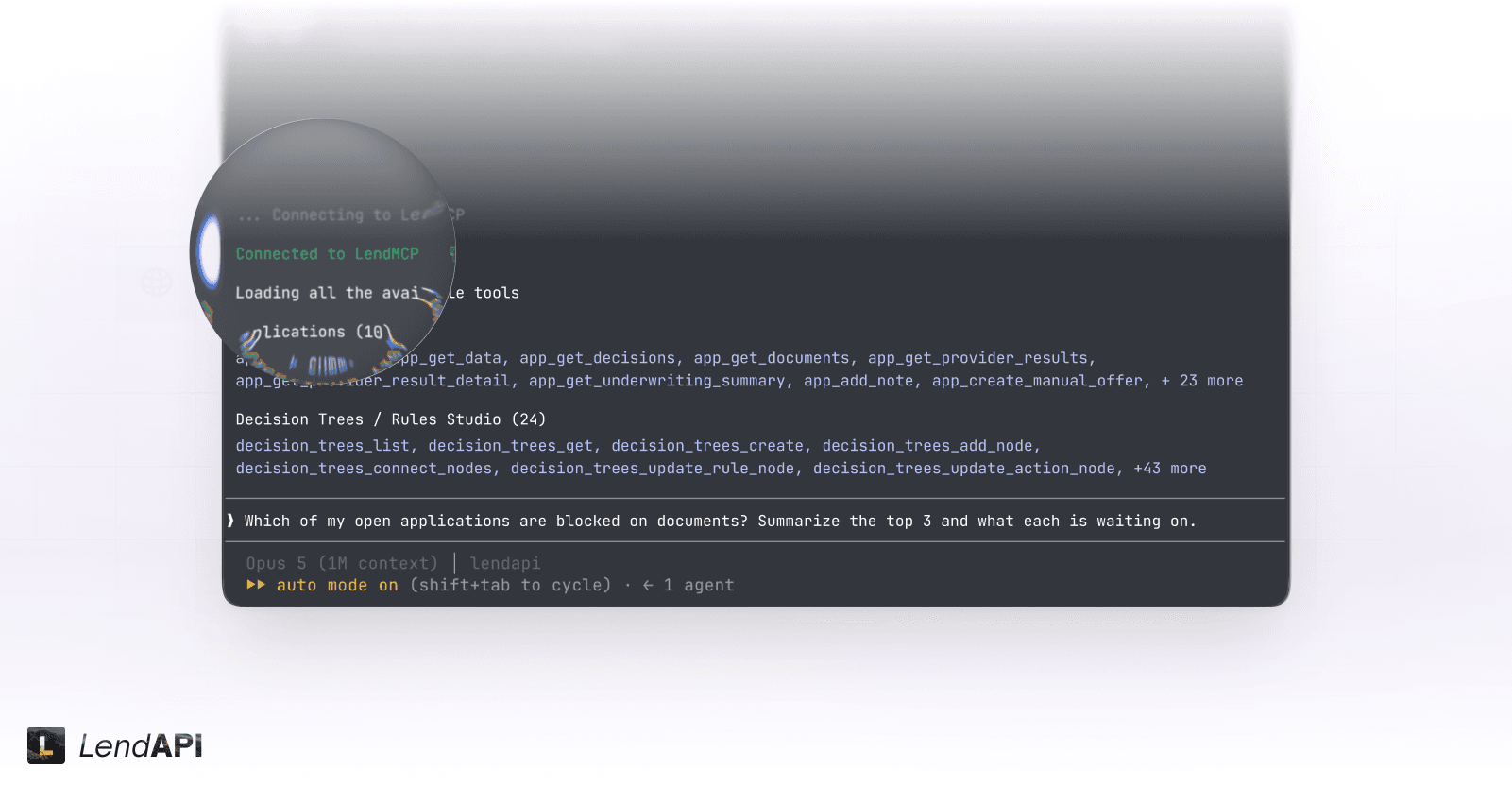
For the last two years, "AI in lending" mostly meant features we built for you. LendMCP flips that around. It's a remote Model Context Protocol (MCP) server — the emerging standard for connecting AI assistants to real systems — that lets you point Claude, or any MCP-capable AI client, straight at LendAPI and have it actually do the work. Our whole reason for building it: the ability to compose and update an entire underwriting workflow — variables, rules, outcomes, decisioning — can now be orchestrated by an agent, not just clicked together by hand.
Think of it as giving your AI a secure, authenticated seat inside your lending stack. You connect with your own machine token, everything stays scoped to your tenant, and it respects your live-versus-sandbox setup automatically — so an agent only ever sees and touches what it's allowed to.
What your agents can actually do
This isn't a chatbot bolted onto a help center. Through LendMCP, an agent can work an application end to end:
Read the full picture — pull an application's data, its decisions, its documents, provider and integration results, and a underwriting summary.
Move work forward — update an application's stage, add notes, and create a manual offer.
Build and run your decisioning — create decision trees, add and connect nodes, edit rule and action logic, manage versions, set the default version, and run a tree against an application.
Work with your building blocks — list and create variables, and list your products and outcomes.
Put together, that means you can ask your AI to "summarize where application #4578 stands and what's blocking it," "re-run the decision tree now that the new document is in," or "spin up a variable and wire it into the rule" — in plain language, against your real data, with your permissions.
Why it matters
Every lender's team spends hours on work that is really just moving information between screens. LendMCP lets you hand that to an agent that never gets tired and always follows your rules — a genuine force multiplier for underwriting and operations, and a foundation we'll keep building on.
Repeat steps in a flow, automatically
New feature: The Loop node in Flow Builder
Some work needs to be checked, and checked again — poll a partner for a result, wait, look again. Until now that meant building a separate scheduled flow or re-triggering by hand. The new Loop node does it for you: drop steps into the loop container, set an exit condition with the same builder you already use, and let it run.
It's built to be safe and readable. The loop leaves through a clear Pass exit when your condition is met, or a Timeout exit when it hits the maximum attempts you set — and each can lead somewhere different, so "we got what we needed" and "we gave up waiting" are separate, handled paths. Every loop even records why it ended as a variable your later steps can branch on.

Get notified about the stages you care about
Improvement: Per-stage notifications, and mentions that notify
Settings now has a Notify toggle on each application stage. Turn it on for the stages that matter, and the assigned agent gets a notification whenever an application lands there — no more re-checking an app you're waiting on. It's off by default, works on standard and custom stages, and is set per account, so every team picks its own signal. And to complete the mentions feature from last release, @mentioning a teammate in a note now actually notifies them.

A couple more for the people you serve — and your developers
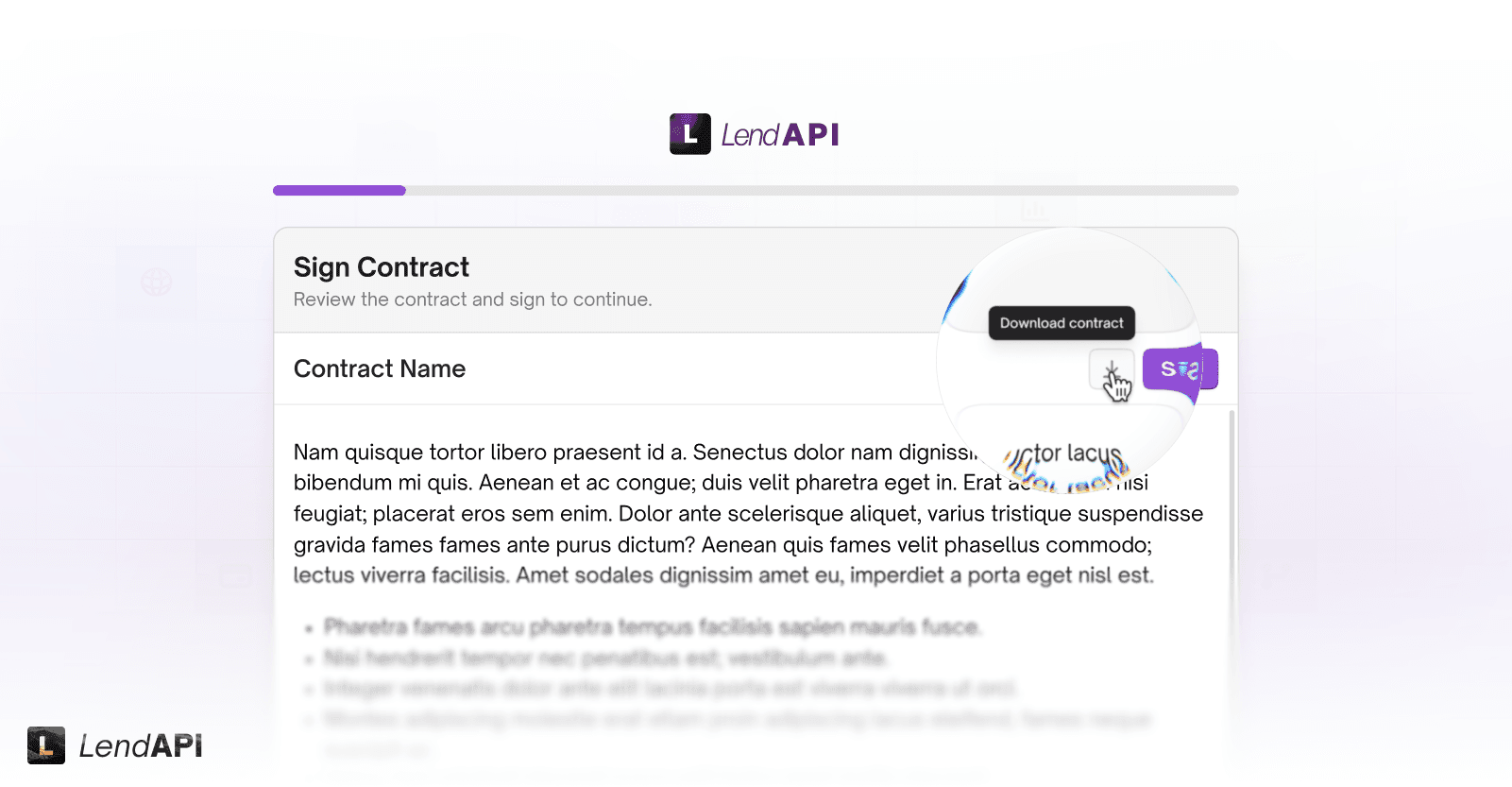
Improvement: Borrowers can download their own contracts
Applicants can now download their contracts directly from the application — rounding out the contract work of the last two releases.
Improvement: Know where every email came from
The platform now shows the source and sender of any email sent from an application — which automation or template produced it, and the address it came from. When a borrower asks about a message, you can answer on the spot.
For developers
Look up all of a customer's applications through a new API endpoint (scoped strictly to your own account); reference JSON variables inside derived variables, so structured integration data feeds your calculated fields; and use two additional configurable statuses to fine-tune automatic withdrawal.
EmbARC — Also got more powerful
More flexible ways to fund
New feature: Revolving credit (LOC)
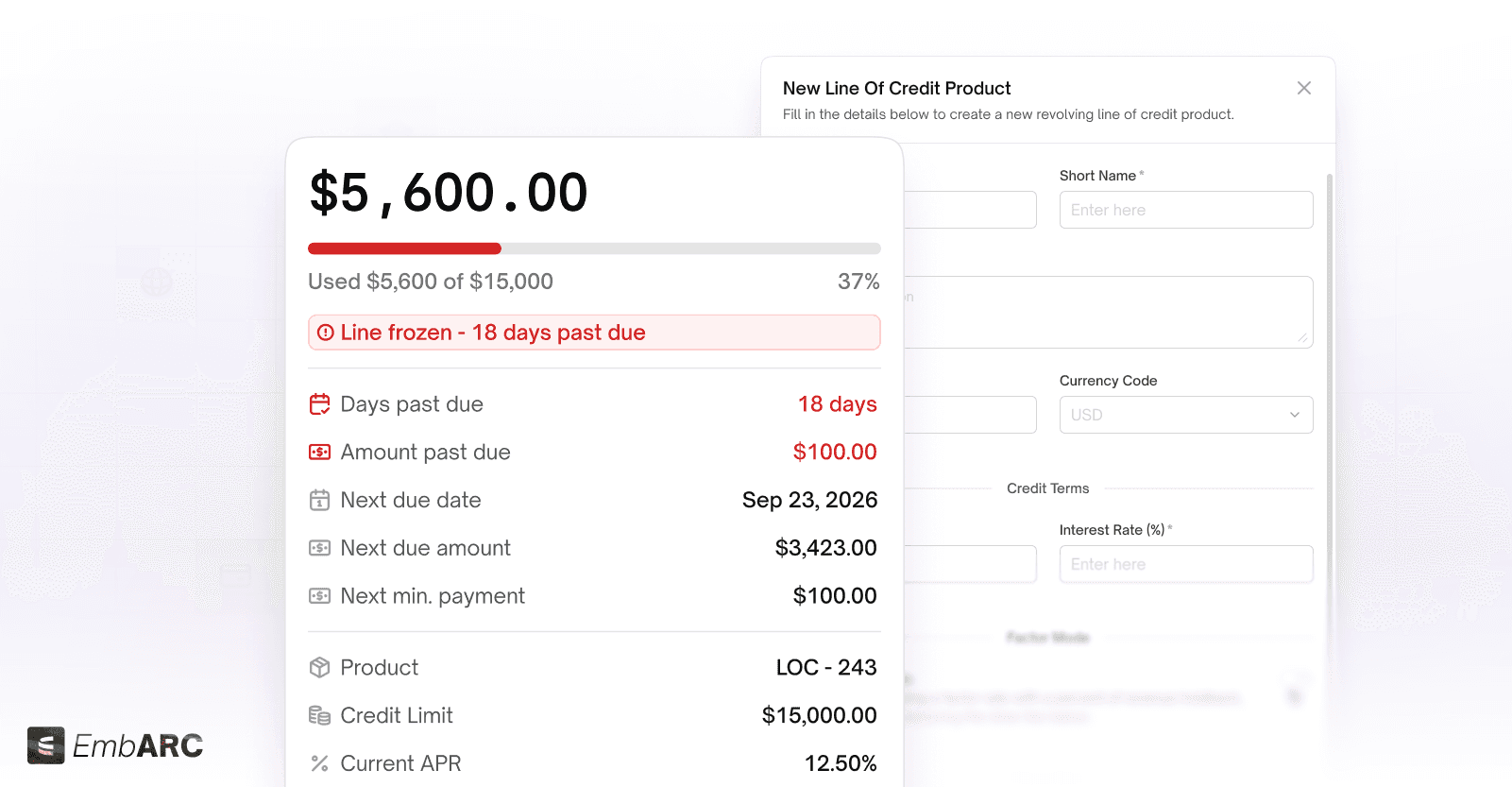
EmbARC now supports revolving credit loan products, giving teams a flexible way to manage approved credit facilities — draws, repayment, and ongoing servicing — with clearer visibility into balances and facility usage over time.
New feature: Daily advance payouts
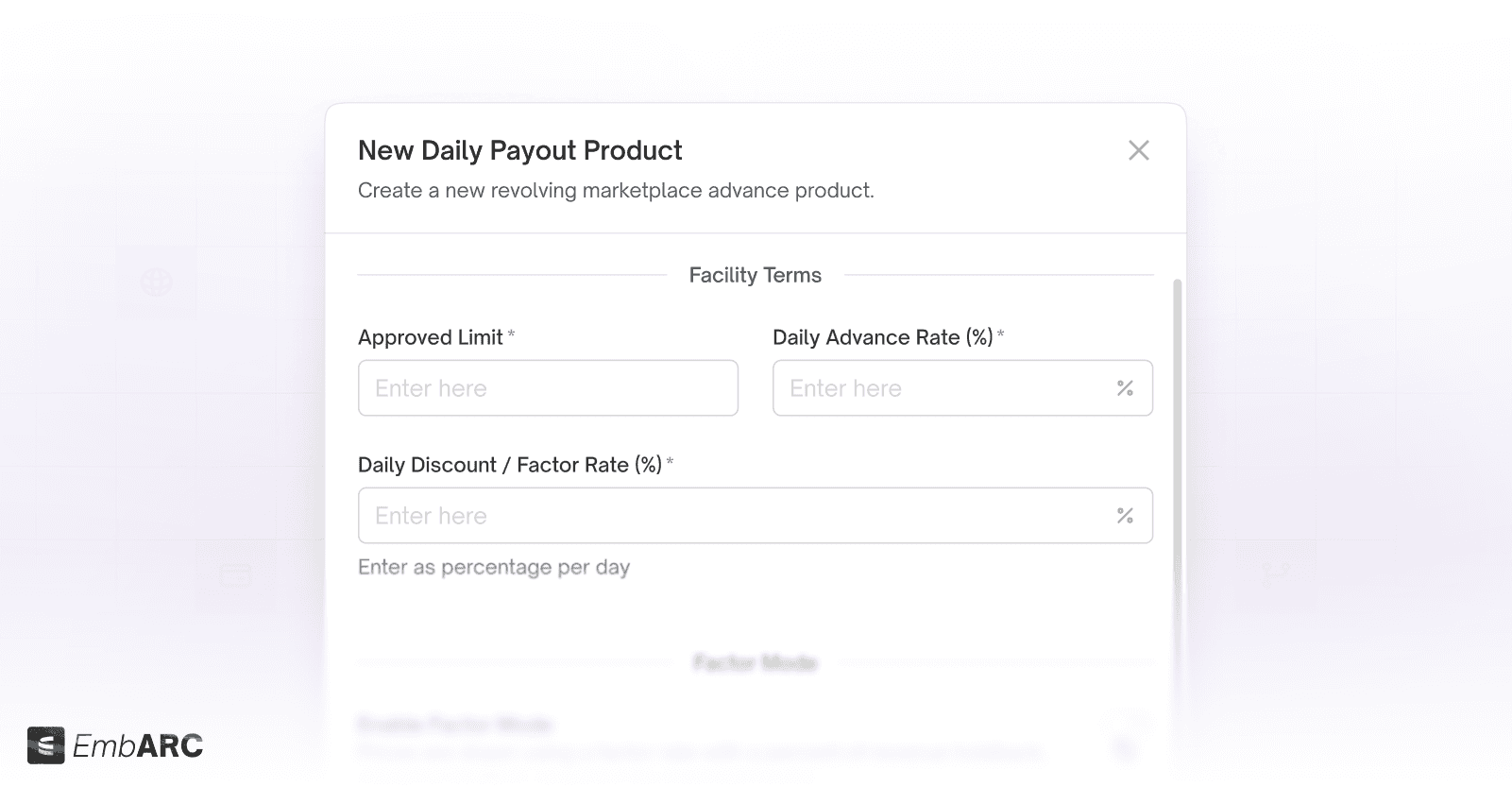
New daily advance payout workflows help eligible businesses access working capital based on daily sales activity, through a more streamlined advance-and-settlement process and clearer visibility into payout activity.
Everything else in this release
Plenty more shipped alongside the headline features.
On the LendAPI side (v3.2.6):
A platform-wide speed-up — we eliminated repeated redundant database queries in the busiest paths (loading an application, delivering webhooks, listing email templates, publishing offer tables), added a new index, and trimmed the front-end build. Webhook delivery in particular should feel noticeably quicker.
More reliable one-time passcodes — mobile OTP now goes out over a registered carrier route that meets the current US business-texting standard, so codes arrive more reliably and get filtered far less often.
Servicing details in the origination dashboard — LMS loan detail now appears inside the LOS agent dashboard, so agents see the full picture on one screen.
Continued modernization — sign-up, login, and business verification moved onto the current framework with the last legacy code removed, plus a round of Flow Builder stability fixes (search, node connections, re-runs, suspended flows) and permission controls that now match exactly what each role can do.
On the EmbARC side (v1.1.3):
Smoother loan setup — loan creation accepts application data and maps budget details more accurately from the LOS, with clearer required-field validation in the New Loan wizard.
More servicing flexibility — overpayment support, the ability to undo loan approvals, weekly and bi-weekly MCA collection schedules, balloon-payment support restored for fixed products, and Rutter payout processing.
Everyday usability — search with the Enter key, better age-validation handling, refined LOC and daily-payout screens with a shared summary panel, and clearer Plaid configuration guidance.
A round of reliability fixes across payments, roles, tables, and the borrower portal.