One of the leading spokespeople for our industry is Theodora Lau. If you aren’t following her on social media, I highly recommend doing so now. She is a proficient writer who frequently covers banking and financial services; her latest book, Banking on (Artificial) Intelligence, immediately caught my attention.
I kindly asked Theodora to send me a copy of the book which she granted my wish graciously and in return, I promised to write a book review of her latest volume.
This book was published around Q4 2025 and I am writing this review about 6 months after the publication of her book so perhaps I have some hindsight or advantage to observe the happenings in A.I. and our industry with respect to her writing. So much has happened in the past six months.
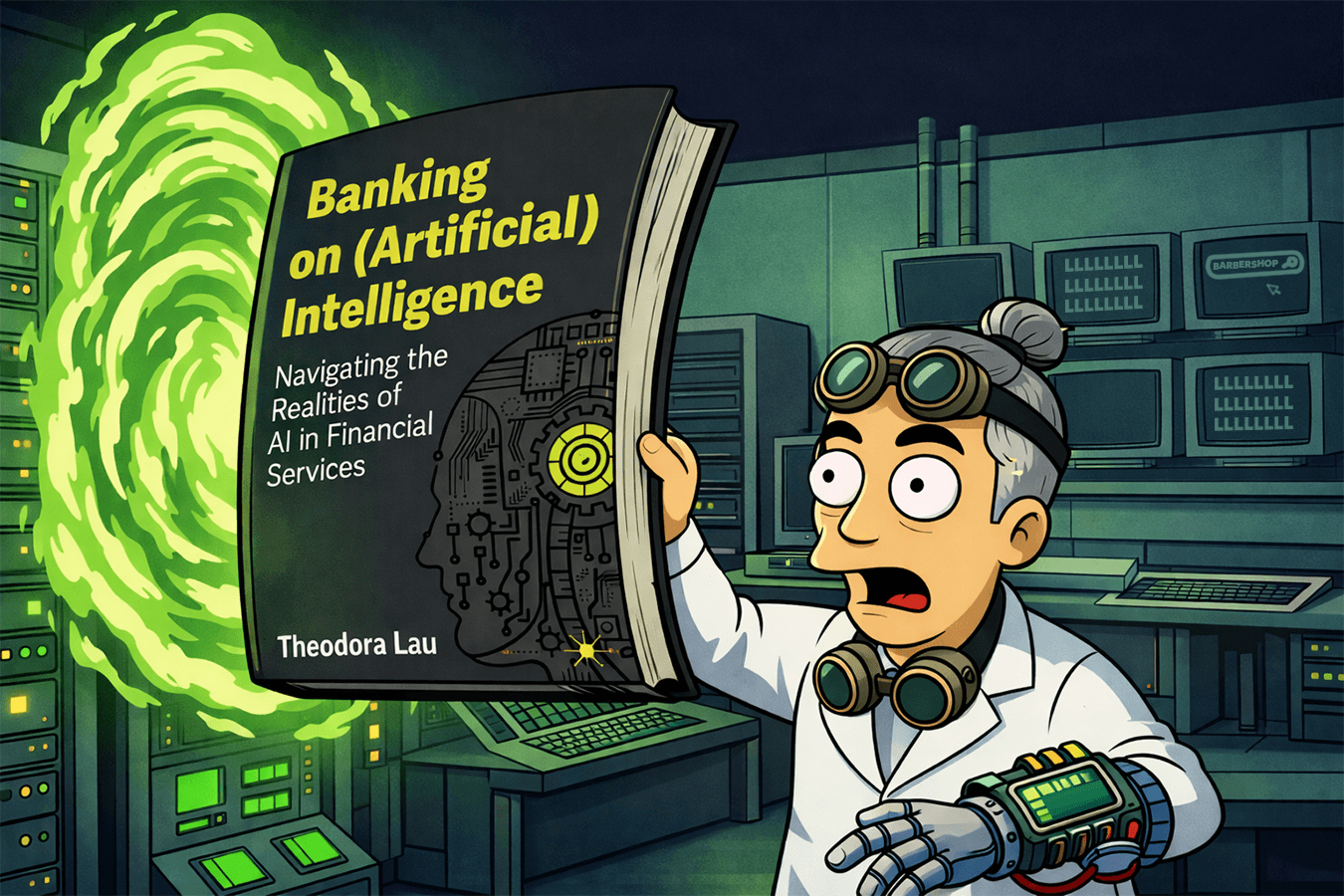
The Book
This is a very well researched book with interviews of key individuals working in banking, fintech and academia. Each page is filled with statistics and references. Each of these citations deserves its own narrative but Theordora kept the readers on track and explored the main themes of her book which is how A.I. is evolving in our society and how it’s making a huge impact in financial services.
This book’s ten separate chapters delve deeply into the advancements of artificial intelligence from the very beginning. From the predecessor of neural networks to today’s large language model, the first few chapters give the reader a solid foundation of where A.I. came from and where it’s going.
The Impact of A.I.
The benefit of A.I. is immeasurable, however, there are downsides to all new inventions. Theodora explored these deficiencies and shortcomings from a cultural, societal, environmental, compliance, safety and humanistic perspective.
From the large amount of electricity data centers need to power our models to the huge amount of water needed to cool these data centers all carries a hefty drag on society when electricity generation is a hot topic and parts of the world today have limited access to water.
In my 2025 Top 10 FinTech Predictions article published on CrowdFundInsider.com, I mentioned that A.I. becoming a new religion, disappearance of jobs, 20 hour work week and ultimately seeing A.I. as either the biggest disruptor or equalizer. Just as Theodora mentioned that A.I. has great potential but at the same time, it has profound effect on employment.
We’ve seen plenty of “AI Layoffs” happening in the past few months. Tens of thousands of people are laid off from Block, Inc. for example as a result of A.I.
Leaders of our industry are openly citing the prospect of A.I. as the reason for layoffs, unabashfully and openly without any reprisal. Perhaps this is the future we need to live with but the majority of the workforce probably won’t be able to adapt to the ever changing landscape quickly.
The Spotlights
What I find interesting and very relatable are these spotlights dotted throughout the book to highlight experts from each field related to the chapters of the book in question.
For instance, Theodora interviewed a few folks that I know. One of them is Ryan Hildebrand, Chief Innovation Officer of Bankwell. Ryan predicts that in the not too distant future, banks will operate with less than a handful of people. Most of the tasks a banker will perform could easily be handled with A.I.. Compression of overhead will be passed to the consumers as a form of savings to provide even more returns to bank clients.
In another Spotlight, the Founder and CEO of Casca cited his company is taking charge and helping banks and community banks to transform their entire digital strategy to get these hundred year old institutions to completely rethink automation and getting ready for the age of A.I.
We’ve certainly talked to a ton of banks as well. All of them want to double their portfolio, clients but none of them want to double their staff and branch network. The delta has to be solved by massive acceptance of automation which will mainly be driven by artificial intelligence.
All Aspects of Financial Services Are Impacted
Whether you work in lending, wealth management, insurance or banking, your clients demand automation and instant resolution of their problems and concerns.
For a long while, we sort of joked about how “OpenAI Wrapper” companies have served no real value with no real IP, however, in the past six months or so, we see great innovation in agentic technology.
Flow builders plus contextual analysis of conversations with real humans powers some of the new startups that create massive automation addressing specific needs in the nichest of areas. Single task agents are popping up everywhere, whether it is to chat with consumers or digest scanned documents, these single task agents are the beginning of something new and will become more complex over time.
Responsibility of A.I.
There’s been a lot of discussion about A.I. safety, guard rails. Many countries have published their own guidelines around A.I. models and the use of A.I., this book has a very comprehensive list of regional regulations published recently by newly established authorities.
We need to work on guardrails to give A.I. a sense of right and wrong. And most importantly, A.I. needs to understand the consequences of its action and suggestions. No longer can we tolerate “You’re right, I was wrong” or shrugging its digital shoulders and pretend that they are innocent. We need regulation and a further set of tests to give these models consciousness.
There are a ton of companies working on creating safety harnesses around A.I. models but we also don’t want to constrain its creativity and make it dull and useless. However, the future is clearly ahead of us and our reliance on A.I. making the most critical decisions with grievous consequences is right in front of us.
Five Stars
If you are interested in the intersection of A.I. and financial services, you should pick up this book. It is easy to read, full of hard hitting statistics and references. Spotlights from experts bring each chapter together with real world narratives.
This e-book is available to download from this link, sourced directly from Theodora: https://link.springer.com/book/10.1007/978-3-031-81647-5
To purchase this book on Amazon, please use this link (directly from the Author).

The Cooperative Blueprint: How Four Credit Unions Built Financial Empires Around Specific American Working Classes
LendAPI Team
•
Perspective

Western Regional Powerhouses: Scaling Modern Cooperative Finance
LendAPI Team
•
Perspective

Powering the Cooperative Movement: A Deep Dive into America's Top Four Mega Credit Unions
LendAPI Team
•
Perspective